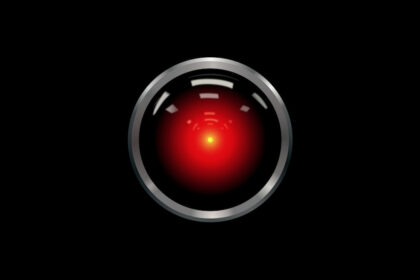

äußerst lesenwert, ein grundlegender Artikel über Computer, künstliche Intelligenz und wohin das alles möglicherweise hinmarschiert:
TURING’S CATHEDRAL [10.24.05]
A visit to Google on the occasion of the 60th anniversary of John von Neumann’s proposal for a digital computer
by George Dyson
Auszüge:
However, once the digital universe is thoroughly mapped, and initialized by us searching for meaningful things and following meaningful paths, it will inevitably be colonized by codes that will start doing things with the results. Once a system of template-based-addressing is in place, the door is opened to code that can interact directly with other code, free at last from a rigid bureaucracy requiring that every bit be assigned an exact address. You can (and a few people already are) write instructions that say „Do THIS with THAT“ — without having to specify exactly Where or When. This revolution will start with simple, basic coded objects, on the level of nucleotides heading out on their own and bringing amino acids back to a collective nest. It is 1945 all over again.
…
We can divide the computational universe into three sectors: computable problems; non-computable problems (that can be given a finite, exact description but have no effective procedure to deliver a definite result); and, finally, questions whose answers are, in principle, computable, but that, in practice, we are unable to ask in unambiguous language that computers can understand.

We do most of our computing in the first sector, but we do most of our living (and thinking) in the third. In the real world, most of the time, finding an answer is easier than defining the question. It’s easier to draw something that looks like a cat, for instance, than to describe what, exactly, makes something look like a cat. A child scribbles indiscriminately, and eventually something appears that resembles a cat. A solution finds the problem, not the other way around. The world starts making sense, and the meaningless scribbles (and a huge number of neurons) are left behind.
This is why Google works so well. All the answers in the known universe are there, and some very ingenious algorithms are in place to map them to questions that people ask.
und Dyson schließt den Artikel mit den Worten eines SF-Autors namens Simon Ings ab:
„When our machines overtook us, too complex and efficient for us to control, they did it so fast and so smoothly and so usefully, only a fool or a prophet would have dared complain.“

Unser Zins-Tipp
Eröffne jetzt dein kostenloses Myntro Festgeld und erhalte 3,3 Prozent Zinsen auf dein Geld – und das garantiert für 12 Monate!
Anzeige
via O’Reilly Radar